
HYDE-SMITH SEEKS INPUT ON IMPROVING GRAIN INSPECTIONS LAW TO BENEFIT MISS. GRAIN EXPORTS
Senate Ag Committee Hearing Weighs Improvements to U.S. Grain Standards Act
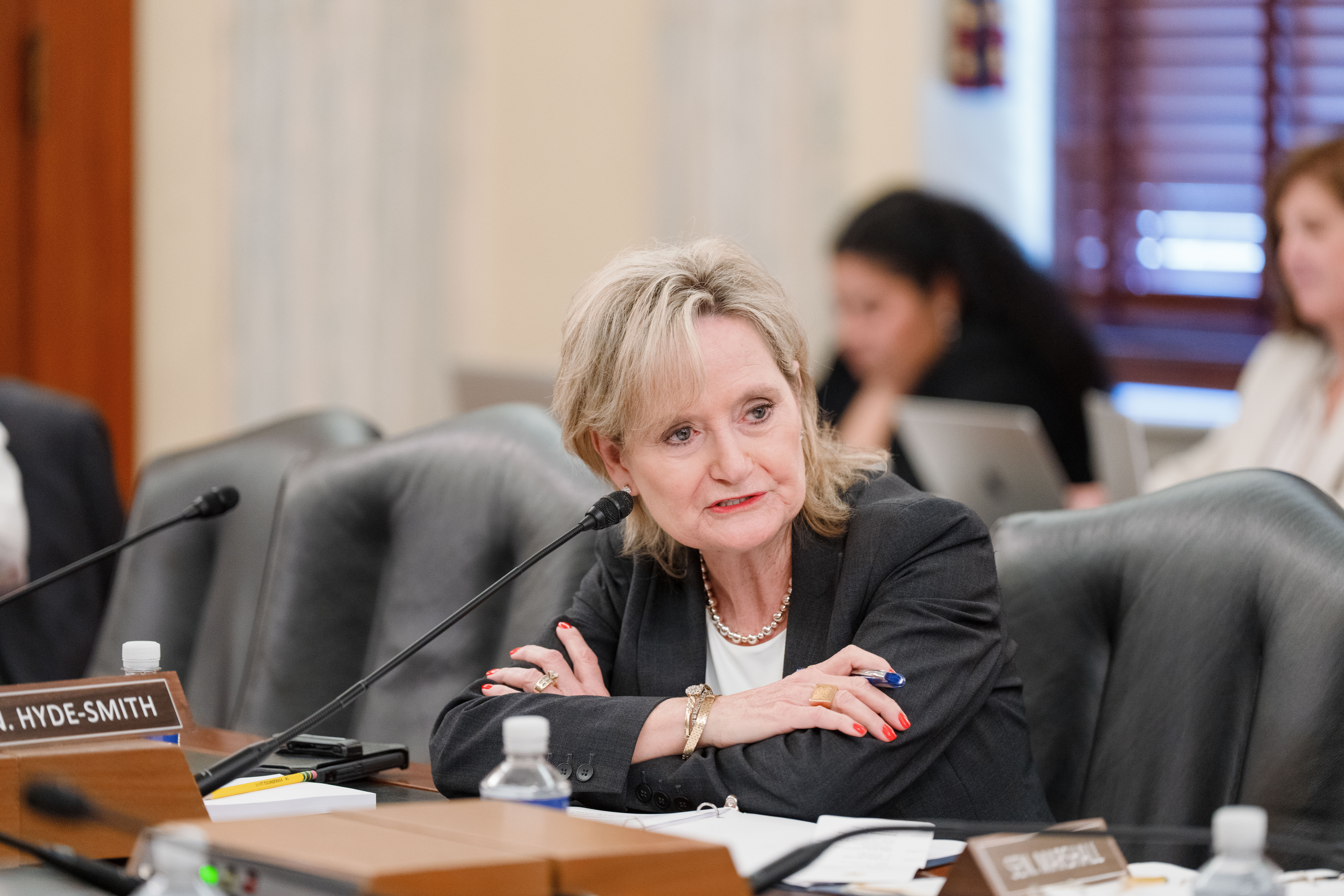
VIDEO: Senator Hyde-Smith Asks Witnesses How to Improve U.S. Grain Standards Act.
WASHINGTON, D.C. – U.S. Senator Cindy Hyde-Smith (R-Miss.) today solicited ideas from witnesses on how Congress can improve the U.S. Grain Standards Act (USGSA), a law that is important to exporting the rice, soybeans, and corn grown by Mississippi farmers.
Hyde-Smith on Tuesday afternoon participated in a Senate Agriculture Committee hearing titled, Perspectives on Reauthorization of the U.S. Grain Standards Act. The USGSA, parts of which expire Sept. 30, sets marketing standards for grains and oilseeds. It also sets procedures for grain inspection and weighing.
“Mississippi farmers contribute significantly to our country’s grain production, particularly through crops like rice, soybeans, and corn. These crops are exported down the Mississippi River and through the Gulf of America, which supports several grain transport operations in my home state. Ensuring we maintain the integrity of our inspection system is of paramount importance to me, especially as it relates to our export markets,” Hyde-Smith said.
USGSA components set to expire include the authority for an advisory committee to advise the Federal Grain Inspection Service (FGIS), to receive appropriations, or to charge fees. The lack of these authorities would hinder the ability to inspect and weigh exported grains and oilseeds.
“While our overall agriculture trade surplus has evaporated into what USDA now projects to be a $49 billion deficit in 2025, grain continues to be a bright spot for agriculture. In fact, America enjoys a $65 billion trade surplus on U.S. grains and oilseeds,” Hyde-Smith said. “This is a credit to our farmers, who continue to grow the highest-quality grain in the world. It’s a credit to our transportation infrastructure, including critical American waterways, highways, and rail systems. And it is the result of decades of diligent work to develop and grow markets.”
Despite the success of the USGSA, Hyde-Smith asked the witnesses to discuss what Congress should include in reauthorizing legislation to overcome new challenges facing grain exporters.
An overarching recommendation was to provide new authorities and resources for FGIS to develop and adopt new technologies to aid in inspecting and weighing products.
“I urge the Committee to reauthorize the Act with a modest toolbox of new authorities for FGIS to speed technology development. Specifically, Congress should clarify in the statute that FGIS may leverage official agencies for R&D, provide Other Transactions Authority for inspection technology research and development, and establish a modest, dedicated funding account—through user fees and appropriations—to support the evaluation and deployment of new technology,” said Kia Mikesh, president of the American Association of Grain Inspection and Weighing Agencies.
Nicholas Friant, chairman of the Grain Grades and Weights Committee National Grain and Feed Association, suggested changes to facilitate a timelier replacement of members of the Grain Inspection Advisory Committee, whose members serve three-year terms to advise FGIS.
Friant also cited work with Hyde-Smith and Senator John Hoeven (R-N.D.) to demonstrate the effectiveness of the Grain Inspection Advisory Committee.
“I think one really good success story, and I want to thank Senator Hyde-Smith and Senator Hoven, had to deal with FDA actionable grain. That was something that the committee brought to the agency and said, ‘Here’s some concerns, here's some changes we would like to see happen.’ FGIS took those recommendations from the committee back worked with FDA and then, as I mentioned the support from Senator Hyde-Smith and Senator Hoven to help the process along, we ended up with some new directives and direction that has made it significantly easier for the industry to manage,” Friant testified. “So really truly a good success story of how that advisory committee worked and the agency took what was recommended and turned it into something actionable for the industry.”
Another targeted funding to plus-up storage capacity to make the marketing of grains and oilseeds more predictable, and more education for farmers to learn how best to manage that storage.
Additionally, all witnesses discussed protecting trust in the grain inspection system.
“We know that for those who buy U.S. grain, both domestic and international, must trust that our grain inspection system functions properly. This trust in a functional system ensures that farmers, merchandisers, and end users all know they are operating within a system that is transparent, consistent, and science-based,” Hyde-Smith said. “I hear regularly from farmers and grain elevator operators in Mississippi who rely on the grain inspection system to protect the value of their grain and ensure they’re competing on a level playing field.”
The Senate Agriculture Committee is currently working on legislative language to reauthorize the USGSA, which could differ somewhat from a reauthorization measure approved by the House Agriculture Committee on July 22.
###