
HYDE-SMITH, COMMITTEE ADDRESS BIOMEDICAL RESEARCH OUTLOOK AS NIH CHANGES LOOM
Miss. Senator Looks at Possible Effects for UMMC, Jackson Heart Study, University-based Research
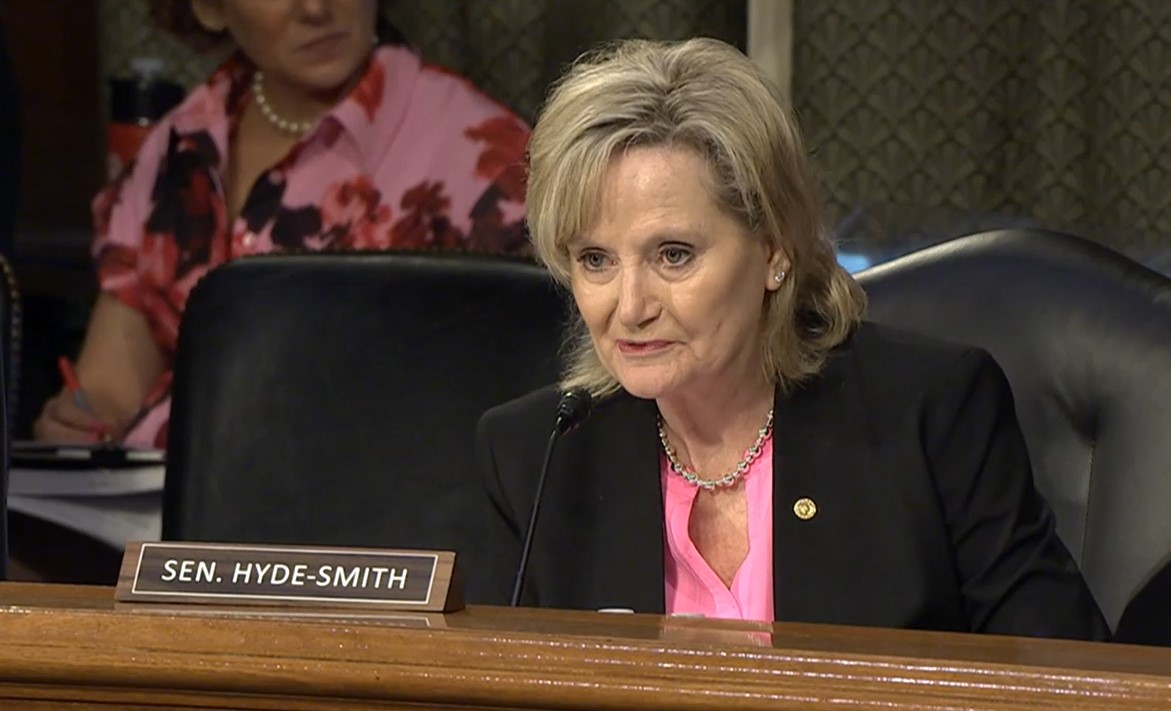
WASHINGTON, D.C. – U.S. Senator Cindy Hyde-Smith (R-Miss.) today explored how potential changes in National Institutes of Health budgeting could affect biomedical research activities in Mississippi, where such funding has been deployed to research health disparities unique to the state.
Hyde-Smith addressed the medical research conducted in Mississippi as part of the Senate Appropriations Committee hearing, Biomedical Research: Keeping America’s Edge in Innovation. The hearing was called to begin exploring how changes sought by the U.S. Department of Health and Human Services and National Institutes of Health (NIH) could affect federal health-related research across the nation.
“This hearing was useful and informative in that we will use this testimony as a guide in developing biomedical and medical research funding bills this year. As the administration looks to improve the efficiency of the nation’s health programs, I want to make sure that Mississippi is able to maintain and grow its already significant medical research capabilities,” said Hyde-Smith, who also serves on the appropriation subcommittee that funds health and education programs.
Hyde-Smith posed questions related to the years-long push by the University of Mississippi Medical Center (UMMC) to become a National Cancer Institute-designated cancer center, importance of continued funding for the Jackson Heart Study, and sustained backing for the NIH Institutional Development Award (IDeA) program that allots federal research dollars to Mississippi colleges and universities.
“To date, there are no NCI-designated centers in Mississippi, Louisiana, or Arkansas. This situation requires Mississippians to travel significant distances for advanced cancer care,” Hyde-Smith said. “How could cancer research funding cuts affect institutions, like UMMC, in their efforts to achieve NCI status?”
Barry Paul Sleckman, M.D., Ph.D., director of the University of Alabama at Birmingham O’Neal Comprehensive Cancer Center, said the UMMC bid to become an NCI-Designated Cancer Center could remain in a “holding pattern” if federal cancer research funding is reduced.
“Although I don’t have crystal ball, I would imagine that the rate of new cancer center designations, which over the last five years has been about one or so per year, will lessen. There are many cancer centers, including the one in your own state, that are kind of in a holding pattern, you know, waiting for the control tower to let them know it is time to land. And those will have to stay holding for a longer period of time,” Sleckman said.
Hyde-Smith asked Sudip Parikh, Ph.D., of the American Association for the Advancement of Science, to speak to the importance of continued federal funding for longitudinal, population-based studies like the Jackson Heart Study.
“At UMMC, we do longstanding research studies. The Jackson Heart Study, which studies cardiovascular health and other things that address risk factors for and prevention of dementia. Both of these studies have been funded by NIH for over 25 years. Understanding these complex conditions and how to address them best is not a fast process, and requires years of study and investment,” Hyde-Smith said.
Parikh said, “To follow those populations for 25 years and to follow them for next 25 years is how we’re going to ensure that the access, the treatments, and the cures that are available in Jackson are also available in the Delta, and that’s the only way it will happen. If the Jackson Heart Study and others feel at risk, which surprisingly they do and I’m always surprised by that, but they feel at risk right now as do many other studies across the country. We have got to be able to put forth a vision that says this is what we’re going to do and this is priority.”
Finally, Hyde-Smith signaled her continued support for the NIH Institutional Development Award or “IDeA” program, which broadens the geographical distribution of NIH funding for biomedical research and enhances research capacity in states, like Mississippi, that generally receive lower levels of NIH funding. The Senator also indicated she will reintroduce her IDeA Reauthorization Act.
“The IDeA program has had a profound impact in my home state of Mississippi. It has helped correct the historic imbalance in federal research funding, which has been concentrated at a small number of legacy institutions. IDeA has helped unlock innovations at schools across my state where cutting-edge research is being conducted,” Hyde-Smith said.
###